
“I always think that one of the easiest ways to remember to love the world is to remember that you have to leave it at some point.” –Ada Limón, Where the Light Comes From
On Saturday, I took part in a Jukai ceremony at my Zen Temple. My Buddhist path is one that started many years ago, and this weekend’s event is a milestone. The first religious ceremony I’ve ever participated in and most likely the only.
I credit my parents for raising me with no religious tradition. My mom was a lapsed Catholic who experienced the cruelty and misery of the Church in a variety of ways. The fear of hell stayed with her for her entire life. She told me that she knew she didn’t want her kids to have the type of experience she’d had. However, we had an image of The Most Sacred Heart of Jesus on our refrigerator and an image of the Last Supper in our dining room, so the iconography was there, but I don’t remember ever praying as a family over meals or anything.
My great grandmother, who lived next door to us, was the most outwardly religious person. She regularly watched the televangelists on one of the three tv channels we could get in rural Ohio in the 1980s, and sent the preachers money. A point of irritation with my grandma and dad considering none of us had much money. My dad never spoke of any type of belief until toward the end of his life, when he asked to speak to a preacher while in Hospice care. I think he had a vague belief in God…the way many people do. Mostly agnostic but not put off by the possibility. But also not worried by it.
I was exposed to Buddhism as a teenager when I became deeply interested in the counterculture of the 1960s and the Beat culture of the 1950s. Allen Ginsberg, Gary Snyder, Jack Kerouac all wrote about and spoke about Zen Buddhism, with Gary Snyder becoming a true practitioner of Buddhism and maybe Ginsberg too. Kerouac was more a dabbler. Alan Watts also brought Zen to the masses during this time and even earlier, though I’ve never read anything by Watts.
Zen Buddhism always resonated to me. The only certainty is the moment you’re in, so you should appreciate it. Simple but not easily done without intention. And there is more to it than that, but I’ll stop there.
I never practiced zazen (seating meditation) with any regularity, but I read a lot. And I tried to be mindful with varying degrees of success. But as I’ve grown and as I’ve lost family members and friends, I discovered I wanted to focus my time more intentionally on following this path. Grief and loss are powerful motivators to wake up to the world.
Zen is about waking up. That’s the simplest explanation I can provide and language is an inadequate tool for trying to talk about it. It’s easy to get in our own way or get caught up with trying to explain. No explanations are necessary.
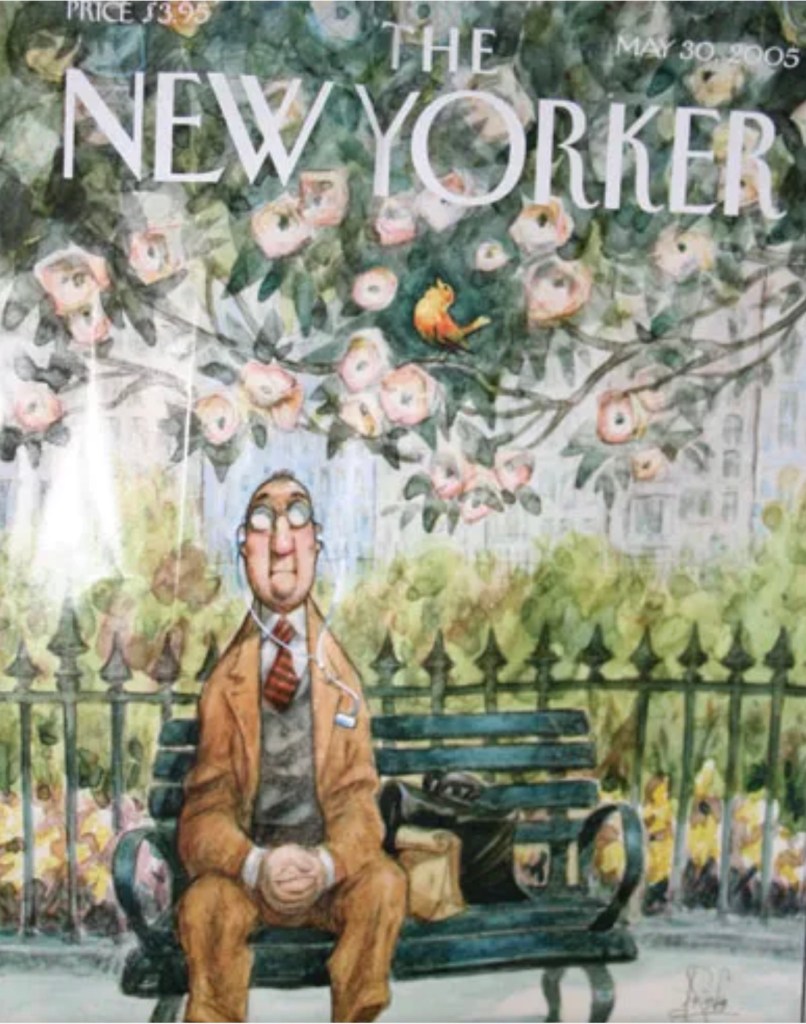
Many years ago, perhaps when iPods were becoming more and more common—so around 2008 or so? (EDIT! I found the cover (pictured above) and it was 2005)—I remember seeing a New Yorker magazine cover of a man sitting on a bench listening to his iPod while a bird sang its song in the branches above. It hit me immediately. I don’t want to go through the world, missing out on what’s happening around me. The annoying, the beautiful, the repetitive, the heartbreaking. I want to do my best to be with each moment completely. Because we have to say goodbye to everything eventually and I want to soak it up in the meantime and spread ease to others while I’m here. That’s what I committed to on Saturday.
 Shannon O